

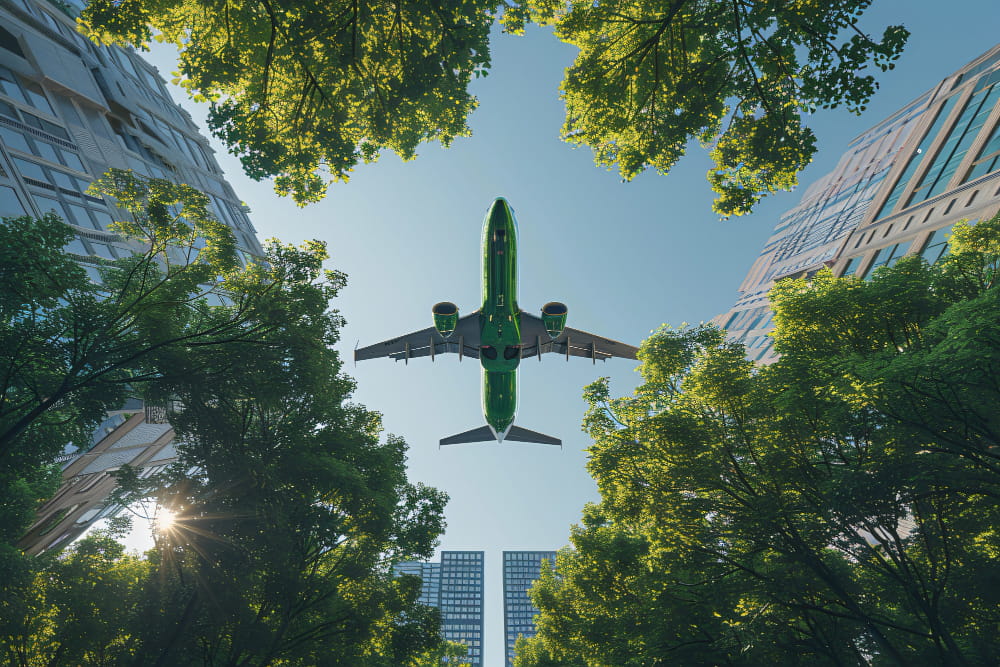
Look up at the sky on any given day and you’ll likely see the thin white trail of an aircraft crossing overhead. For many people, that sight represents opportunity. It means family reunions, business trips, holidays, trade, and global connectivity. Yet it also raises a difficult question that the aviation industry can no longer ignore: how can we continue enjoying the benefits of air travel while reducing its environmental impact?
The challenge is not a small one. Aviation is one of the most difficult sectors to decarbonize because aircraft require enormous amounts of energy to stay airborne. Unlike cars, which can increasingly switch to electric power, long-haul commercial aircraft cannot simply replace jet fuel with batteries using current technology. This reality has pushed airlines, fuel producers, governments, and researchers toward a promising solution known as Sustainable Aviation Fuel, or SAF. While SAF may not be the only answer to aviation’s sustainability challenge, it is increasingly viewed as one of the most practical and immediately deployable solutions available today.
Understanding What Sustainable Aviation Fuel Is
At its core, Sustainable Aviation Fuel is an alternative fuel designed to reduce the lifecycle carbon emissions associated with air travel. Unlike conventional jet fuel, which is derived from fossil resources, SAF can be produced from a variety of renewable and sustainable feedstocks. These may include used cooking oil, agricultural residues, municipal waste, forestry byproducts, and even captured carbon combined with renewable energy.
One of the reasons SAF has attracted so much attention is its compatibility with existing aviation infrastructure. In many cases, it can be blended with conventional jet fuel and used in current aircraft engines without requiring major modifications. That point is important. The aviation industry operates on a massive scale, and replacing entire fleets would be enormously expensive and time-consuming. SAF offers a pathway toward emissions reduction without completely reinventing the aircraft themselves.
Why Aviation Faces a Unique Sustainability Challenge
When discussing climate solutions, electric vehicles often dominate the conversation. Aviation, however, presents a different set of constraints. Commercial aircraft need lightweight, energy-dense fuel to travel long distances. Batteries, while improving steadily, remain significantly heavier than liquid fuels when delivering equivalent energy. For short flights, electric aviation may eventually play a larger role, but for long-haul international routes, alternative solutions are required.
This is where SAF becomes particularly valuable. By utilizing fuels with lower lifecycle emissions, airlines can reduce their carbon footprint while maintaining operational performance. It is not a perfect solution, and it does not eliminate emissions entirely, but it represents meaningful progress in a sector where alternatives are limited. In many ways, SAF is helping bridge the gap between today’s aviation realities and tomorrow’s sustainability ambitions.
Growing Momentum Across the Industry
One of the most interesting developments in recent years has been the level of support SAF is receiving across the aviation ecosystem. Airlines are entering into long-term supply agreements. Governments are introducing incentives and regulatory frameworks. Energy companies are investing in production facilities. Airports are exploring infrastructure upgrades to support increased SAF adoption.
This momentum is reflected in market projections. During my research, I came across Roots Analysis, and they mentioned that the sustainable aviation fuel market size is projected to grow from USD 1.87 billion in 2025 to USD 82.7 billion by 2035, representing a CAGR of 46.1%, during the forecast period till 2035. Those figures highlight the extraordinary pace at which the sector is expected to evolve. Such growth suggests that SAF is moving beyond pilot programs and demonstration projects toward broader commercial deployment.
Beyond Carbon Reduction
Most discussions about SAF focus on emissions, but its potential benefits extend further. Certain types of sustainable aviation fuels can produce fewer particulate emissions compared to traditional jet fuel. This may contribute to improved air quality around airports and potentially reduce the formation of contrails under specific conditions.
There are also broader economic implications. Expanding SAF production creates opportunities within agriculture, waste management, renewable energy, and advanced manufacturing sectors. New supply chains emerge, generating investment and employment opportunities. In this sense, SAF is not merely an environmental initiative. It is becoming part of a larger industrial transformation.
The Challenge of Scaling Production
Despite its promise, SAF faces significant obstacles. The most immediate challenge is production capacity. Current SAF output represents only a small fraction of global aviation fuel demand. Meeting future targets will require substantial investments in feedstock collection, refining technologies, transportation infrastructure, and production facilities.
Cost is another major consideration. SAF generally remains more expensive than conventional jet fuel. Airlines operating in highly competitive markets must carefully balance sustainability goals with financial realities. Many industry experts argue that scaling production is essential for reducing costs. As manufacturing volumes increase and technologies mature, SAF may become increasingly cost-competitive. Still, reaching that point will require sustained collaboration across public and private sectors.
Feedstock Questions and Sustainability Concerns
Interestingly, one of the biggest discussions surrounding SAF involves the question of feedstocks. Not all sustainable fuels are created equal. The environmental benefits depend heavily on how raw materials are sourced, processed, and transported. For example, fuels produced from waste materials may offer different sustainability profiles compared to those derived from dedicated crops.
This has led to increased scrutiny regarding land use, biodiversity impacts, and lifecycle emissions accounting. The industry is actively working to establish standards and certification systems that ensure fuels genuinely deliver the environmental benefits they promise. Transparency and rigorous verification will remain essential as production expands. After all, sustainability is not just about replacing one fuel with another; it is about ensuring that the replacement truly improves environmental outcomes.
Innovation Is Expanding Possibilities
What makes the future of SAF particularly exciting is the pace of innovation. Researchers are exploring advanced production pathways, including synthetic fuels created using renewable electricity and captured carbon dioxide. These technologies have the potential to further reduce lifecycle emissions while expanding feedstock availability.
Advances in biotechnology, chemical engineering, and renewable energy systems are opening new possibilities that seemed distant only a few years ago. The industry is evolving rapidly, and many observers believe today’s SAF technologies represent only the beginning of a much broader transformation.
Looking Toward the Future
The path toward sustainable aviation will likely involve multiple solutions working together. More efficient aircraft, improved operational practices, carbon management strategies, and alternative propulsion technologies all have important roles to play.
Yet SAF occupies a unique position because it can be implemented within existing aviation systems. It offers a practical way to begin reducing emissions now rather than waiting for future technological breakthroughs. That practicality is one of its greatest strengths.
Conclusion
Sustainable Aviation Fuel represents one of the most promising developments in the aviation industry’s effort to address environmental challenges. By providing a lower-emission alternative to conventional jet fuel, SAF offers a realistic pathway toward reducing the carbon footprint of air travel without compromising connectivity.
While significant hurdles remain, particularly regarding cost and production scale, the momentum behind SAF is undeniable. Airlines, governments, fuel producers, and investors increasingly view it as a critical component of aviation’s future. Perhaps what makes SAF so compelling is that it acknowledges a simple reality: people are unlikely to stop flying altogether. Instead, the challenge is finding ways to make flights more sustainable. Sustainable Aviation Fuel may not solve every problem facing aviation, but it represents a meaningful step toward a future where global mobility and environmental responsibility can coexist more effectively.